Why Basements Grow Mold
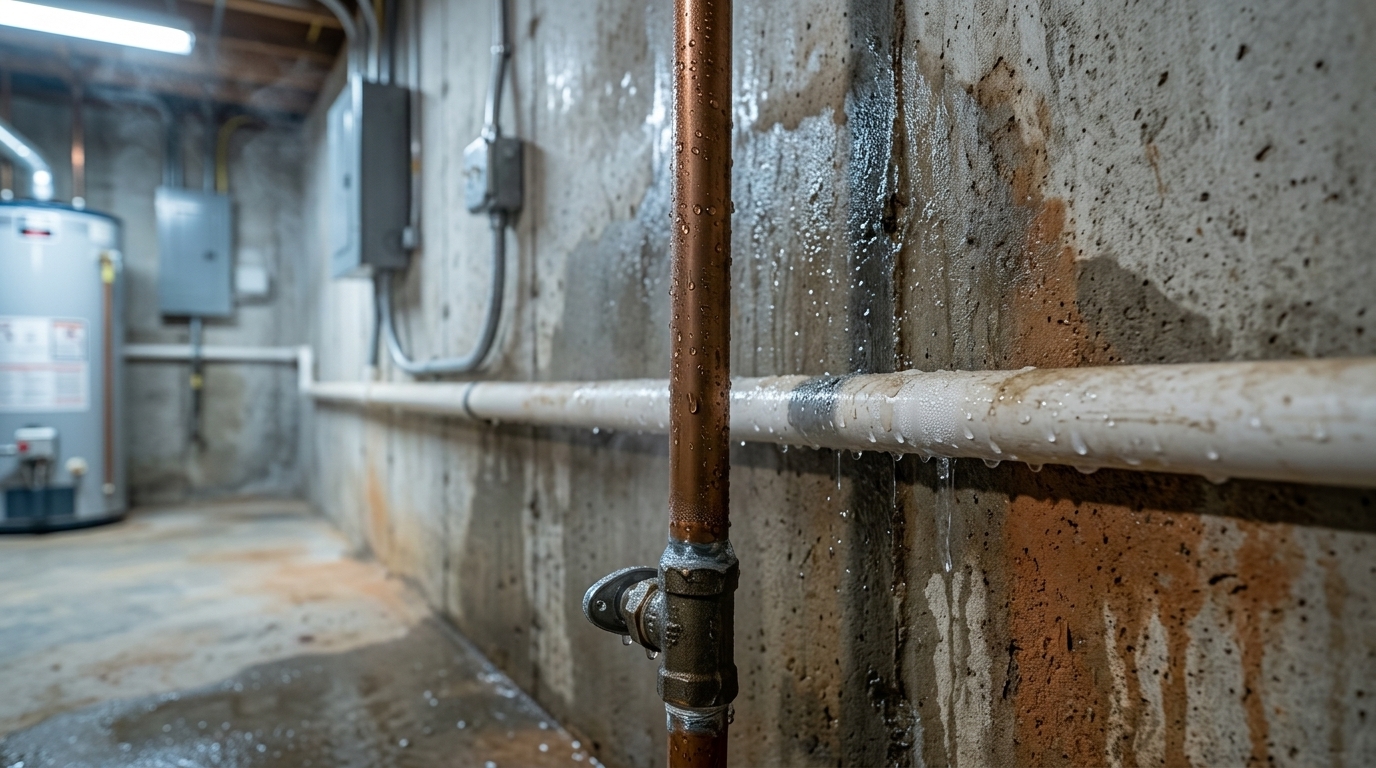
Basements create mold-friendly conditions by nature. They sit below grade, surrounded by soil that holds moisture. The walls stay cooler than the air inside, which creates condensation. And in most homes, basements receive less airflow and sunlight than any other space.
But the specific reasons mold grows in your basement depend on what’s going wrong. Here are the primary moisture sources we identify during inspections:
Foundation Cracks and Seepage
Poured concrete and concrete block foundations develop cracks over time from settling, hydrostatic pressure, and seasonal expansion and contraction. Water finds its way through these cracks, especially during heavy rain. In Atlanta, the red clay soil that surrounds most foundations holds water rather than draining it — creating sustained hydrostatic pressure against basement walls.
We see this constantly in older homes built on Georgia red clay. The clay acts like a bowl around the foundation, trapping rainwater and pushing it against the walls and floor slab. A crack that barely seeps in dry weather becomes a steady water source during Atlanta’s spring and summer storms.
High Humidity and Condensation
Atlanta averages 70% or higher relative humidity for much of the year. When that warm, humid air enters a cooler basement — through open windows, stairwells, or gaps in the building envelope — the temperature drop causes condensation on walls, pipes, and floor surfaces.
The physics are straightforward: for every 1 degree Fahrenheit the air temperature drops, relative humidity increases by approximately 2.2%. A basement that sits at 68 degrees when the outdoor air is 88 degrees and 75% relative humidity becomes a condensation factory. Moisture forms on cool concrete walls and cold-water pipes, and that persistent dampness feeds mold growth.
Poor Drainage and Grading
When the ground around your home slopes toward the foundation instead of away from it, rainwater collects against the basement walls. Clogged or absent gutters make the problem worse — roof runoff dumps directly against the foundation. We regularly find basements with moisture intrusion that stops completely once the grading is corrected and gutters are extended.
Plumbing Leaks
Basements contain water supply lines, drain lines, water heaters, and in many Atlanta homes, laundry hookups. A slow leak from any of these sources provides the sustained moisture that mold needs. Supply line joints, washing machine hoses, and water heater drain pans are the most common culprits we flag during basement inspections.

The Stack Effect: How Basement Mold Affects Your Whole Home
This is the part most homeowners do not realize. Mold in a basement is not just a basement problem.
The stack effect is the natural upward airflow in a building caused by warm air rising and exiting through the upper levels while cooler air is drawn in from below. In a typical home, 40 to 60% of the air you breathe on the main floor originated in the basement or crawlspace. That air carries whatever is down there — including mold spores, mycotoxins, and microbial volatile organic compounds (MVOCs, the chemicals that produce that musty smell).
Think of your house as a chimney. Air enters at the lowest point, rises through each floor, and exits through the attic and upper-level gaps. Your basement is the intake. Every spore, every odor molecule, every particle of dust in that space gets pulled upward into the living areas above.
This is why people sometimes develop symptoms associated with mold exposure — congestion, headaches, fatigue — even when they rarely go into the basement. The exposure is happening on the main floor through the air that migrated up from below.
HVAC Return Vents Make It Worse
Many Metro Atlanta homes have HVAC return vents in the basement. These vents actively pull basement air into the duct system and distribute it throughout the house. Even without the stack effect, a single return vent in a moldy basement turns your HVAC system into a spore distribution network.
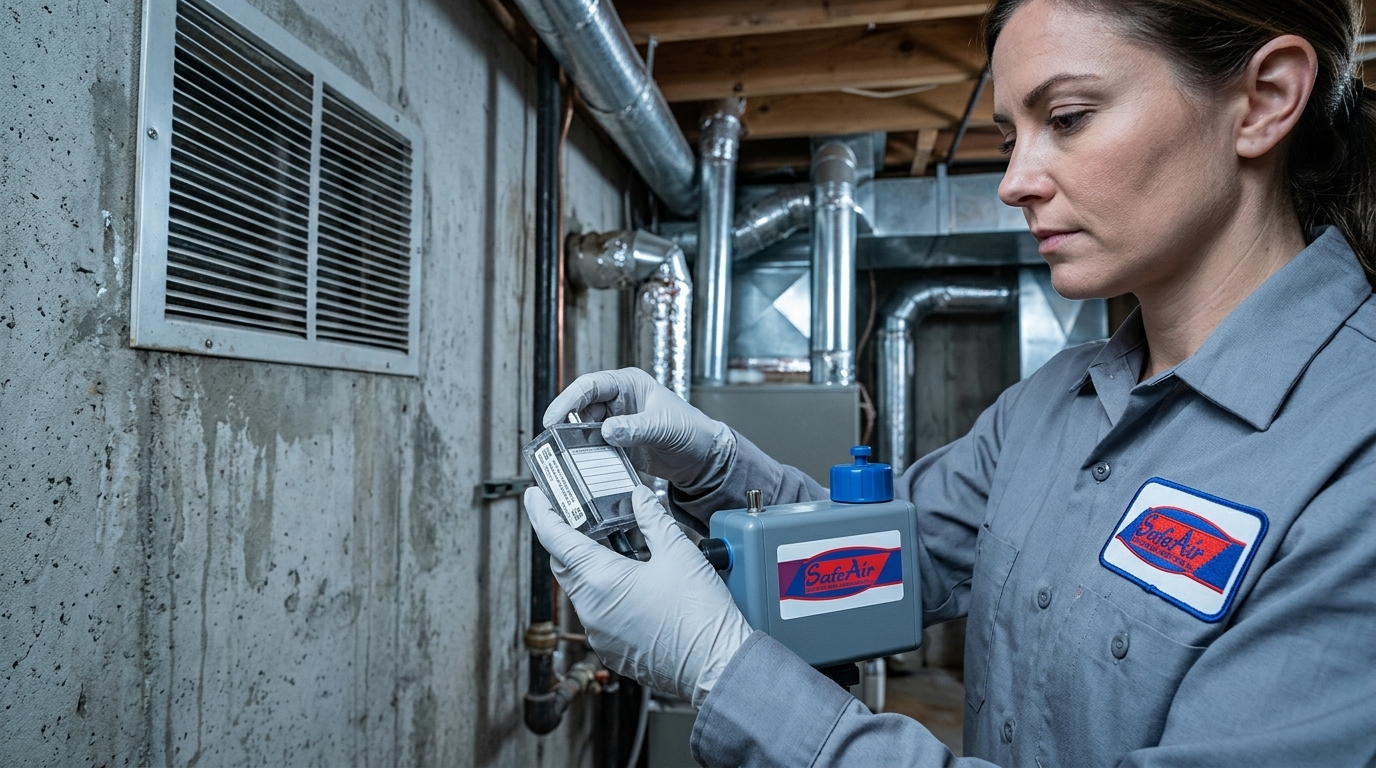
We test for this specifically during air quality assessments. When we place air cassettes on the main floor and in the basement, we can compare spore counts. In homes with basement mold and basement return vents, we frequently find that main-floor spore counts are 60 to 80% of basement levels — far higher than they would be if the air systems were isolated.
If you have a basement mold problem and HVAC returns in the basement, closing those vents temporarily is one of the first practical steps we recommend while the source is being addressed.
Finished vs. Unfinished Basements: Different Risks
The type of basement you have changes both the risk profile and the detection difficulty.
Unfinished Basements
An unfinished basement with exposed concrete walls and floor has one major advantage: visibility. You can see moisture on the walls, spot mold colonies early, and address issues before they spread. The surfaces themselves — concrete, block, metal pipes — are non-porous and resistant to mold penetration. Mold grows on dust, dirt, and organic debris that accumulates on these surfaces, but it generally does not establish deep colonies the way it does on paper-faced drywall.
Cleaning mold from exposed concrete is relatively straightforward. Fix the moisture source, clean the surface, and control humidity going forward.
Finished Basements
Finished basements are where the serious problems develop. Drywall, carpet, wooden framing, and insulation are all organic materials that mold feeds on. And the worst part: these materials hide the moisture source. A slow foundation seep that you would spot immediately on an exposed block wall can saturate drywall from behind for months before any visible sign appears on the interior surface.
By the time you see mold on the painted face of a finished basement wall, the backside of that drywall — and often the wooden framing behind it — has been colonized for weeks or months. Left unchecked, that growth can compromise the framing itself; we cover the long-term effects in our guide on whether mold can cause structural damage. Stachybotrys chartarum, the species people fear most, thrives in exactly this scenario: sustained moisture on cellulose-backed drywall in a dark, low-airflow environment.
We inspected a home in Candler Park last fall where the homeowner had finished the basement five years prior. Beautiful space — media room, guest bedroom, full bathroom. The only symptom was a faint musty smell near the exterior wall of the guest bedroom. Our moisture meter showed readings of 60%+ on the lower three feet of the wall, despite no visible water staining. The lab results from surface samples came back with Stachybotrys chartarum and Chaetomium — both indicators of long-term water intrusion. The remediation company ultimately removed drywall along 22 linear feet of exterior wall, revealing extensive mold growth on the backside that had been active for an estimated two to three years.
The homeowner had no idea. The paint side of the wall looked perfect.
Factor | Unfinished Basement | Finished Basement |
|---|---|---|
Mold visibility | High — surfaces are exposed | Low — mold grows behind walls |
Common species | Cladosporium, Aspergillus, Penicillium on surface debris | Stachybotrys, Chaetomium on drywall and framing |
Detection method | Visual inspection, moisture meter on exposed surfaces | Moisture mapping through walls, air sampling, surface samples |
Remediation scope | Surface cleaning, moisture correction | Wall removal, framing treatment, material replacement |
Typical cost to address | $500–$2,000 | $3,000–$15,000+ depending on scope |
Prevention focus | Humidity control, drainage | Vapor barriers behind walls, proper waterproofing before finishing |
Georgia-Specific Factors That Drive Basement Mold
Atlanta basements face conditions that basements in the Northeast and Midwest do not. Understanding these local factors helps explain why a dry basement in Ohio’s climate can develop mold problems in Georgia.
Red Clay Hydrostatic Pressure
Georgia’s red clay soil (Cecil and Pacolet series, for the geologically curious) has extremely low permeability. When it rains, water saturates the clay and sits against your foundation rather than draining down to the water table. After a heavy Atlanta thunderstorm, that hydrostatic pressure can push water through hairline cracks that stayed dry for years.
The clay also expands when wet and contracts when dry, creating seasonal movement that opens new pathways in foundations over time. Homes built in the 1920s through 1960s in neighborhoods like Grant Park, Inman Park, and the Old Fourth Ward sit on clay that has been going through this cycle for decades.
Temperature Differential and Condensation
During Atlanta’s summer months (May through September), outdoor temperatures regularly exceed 85 to 95 degrees with humidity above 70%. Basement walls in contact with 60-degree soil stay cool. That 25- to 30-degree temperature differential creates persistent condensation — not from a water leak, but from the air itself depositing moisture on every cool surface.
Many homeowners mistake this condensation for a foundation leak. The fix is different: a foundation leak needs waterproofing, while condensation needs dehumidification and air sealing.
Extended Warm Season
Northern basements deal with moisture seasonally. In Georgia, conditions favorable for mold growth exist roughly eight to nine months of the year. Mold needs temperatures above 40 degrees Fahrenheit and relative humidity above 60% to grow actively. Atlanta provides both from March through November, giving mold colonies nearly three-quarters of the year to develop.

Atlanta Neighborhoods with Known Basement Moisture Issues
Certain areas in Metro Atlanta have higher rates of basement moisture problems based on topography, soil composition, age of housing stock, and drainage infrastructure.
Grant Park — One of Atlanta’s oldest neighborhoods, with homes dating to the 1890s. Stone and brick foundations, many without modern waterproofing. The rolling terrain funnels rainwater toward lower-elevation properties. We inspect Grant Park basements frequently.
Inman Park — Similar housing era and foundation types to Grant Park. Many homes have been renovated with finished basements added, sometimes without adequate moisture barriers behind the new walls.
Candler Park — The neighborhood sits in a low area between ridgelines. Several streets have documented stormwater drainage issues that contribute to chronic foundation moisture. We have tested multiple homes on the same block with nearly identical moisture patterns.
Virginia-Highland — The bungalows and Craftsman homes here were built with pier-and-beam foundations and partial basements. The partial basements often lack proper drainage and vapor barriers, creating conditions where moisture collects in the lowest point of the home.
Kirkwood — A mix of original early 1900s construction and recent renovations. Foundation moisture is common in the unrenovated homes, and some renovation projects have sealed basements without properly addressing the exterior drainage first.
This is not an exhaustive list, and having a home in one of these neighborhoods does not guarantee a moisture problem. But if you own a home with a basement in any of these areas and you smell something musty, the odds favor a real moisture source rather than your imagination.
Signs of Basement Mold
Some indicators are obvious. Others require a trained eye — or a trained nose.
Musty odor — MVOCs (microbial volatile organic compounds) are the source of that distinctive musty smell. If you notice it when you walk downstairs, mold is actively growing somewhere in the space. The smell may be stronger near the source, but air movement can distribute it throughout the basement.
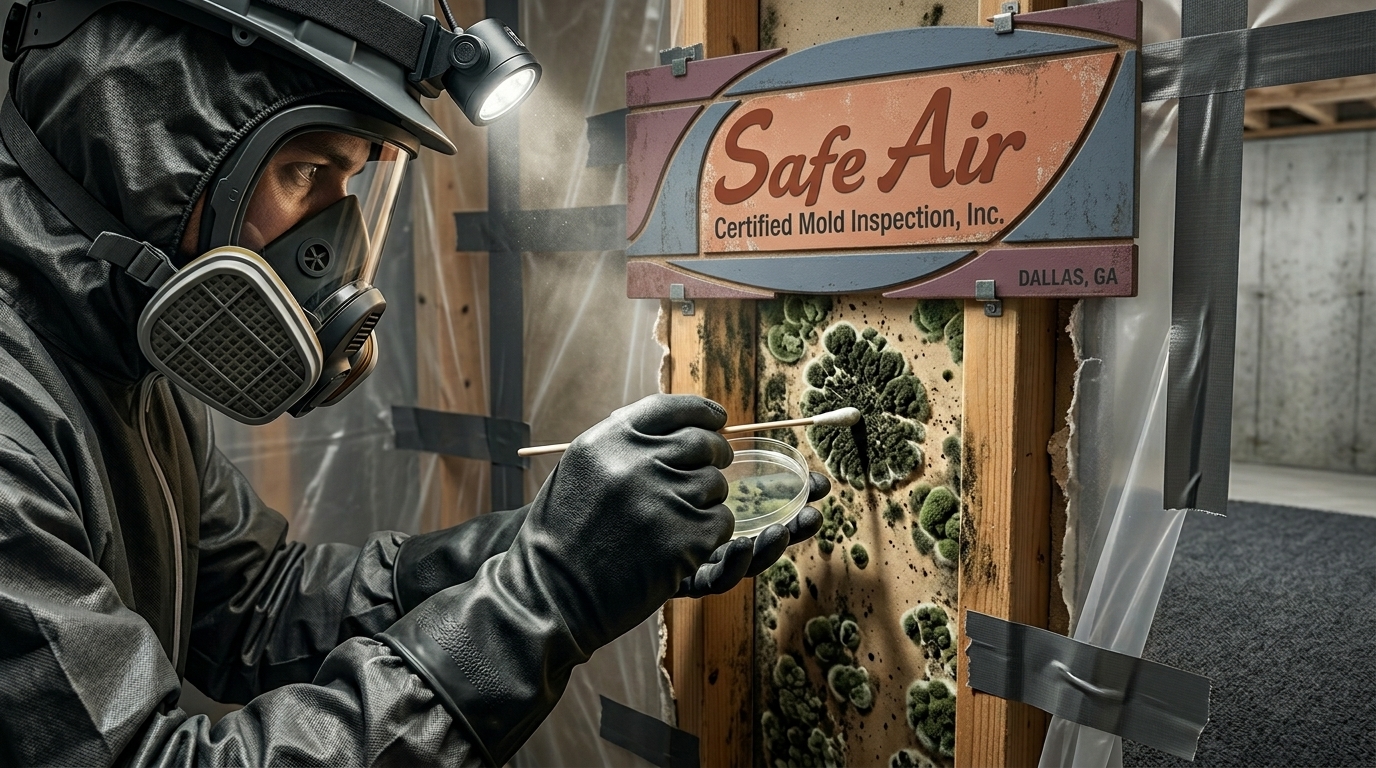
Visible growth — Mold on basement surfaces can appear as black, green, gray, or white patches. On concrete, it often grows in the dust and mineral deposits along the base of walls. On drywall, it may appear as dark spots or discoloration.
Efflorescence vs. mold — This is a common point of confusion. Efflorescence is a white, crystalline deposit that appears on concrete and masonry surfaces when water moves through the material and evaporates, leaving mineral salts behind. It is not mold. However, efflorescence signals that water is migrating through your foundation — the same moisture that can support mold growth nearby. If you see white crystalline deposits on your basement walls, you have a water migration issue that may be feeding mold somewhere less visible.
Water stains — Discoloration on walls or the floor, especially along the base of walls, indicates past or ongoing water intrusion. Even if the surface is dry today, those stains tell a history of moisture that may have already led to mold on the backside of a finished wall.
Peeling paint or bubbling — On painted basement walls, these are signs that moisture is pushing through from behind.

When to Handle It Yourself vs. Call a Professional
A small amount of surface mold on exposed concrete, a utility sink, or a section of unfinished wall is generally a DIY-appropriate situation. Clean the surface with a detergent solution, fix the moisture source (often as simple as improving drainage or running a dehumidifier), and monitor.
Call a professional when:
- The mold covers more than 10 square feet (the EPA’s guideline threshold)
- You can smell mold but cannot see it
- The mold is on finished walls, carpet, or inside the HVAC system
- Anyone in the home has respiratory issues, allergies, or an immune condition
- You’ve cleaned the mold before and it returned
- You’re buying or selling the home and need documented test results
- You want species identification and spore count data before making decisions
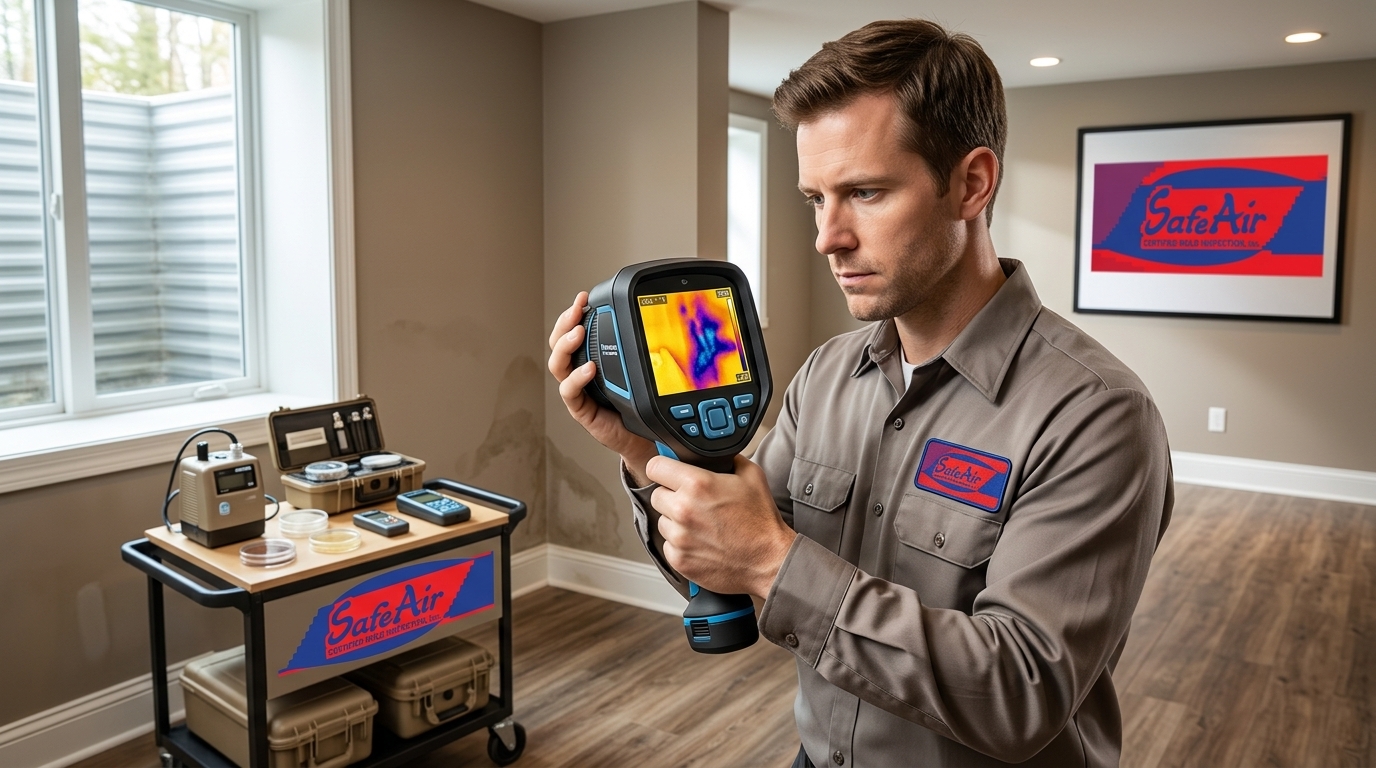
Professional testing through SafeAir includes a visual assessment, moisture mapping with pin and pinless moisture meters, air quality sampling with calibrated pumps, surface sampling when visible growth is present, and a detailed report with lab results, species identification, and specific recommendations. For homes that have already been through remediation, we also perform clearance testing to verify that spore counts have returned to acceptable levels.
A standard mold inspection for a home with basement concerns typically takes 1.5 to 2.5 hours on site, with lab results back in 3 to 5 business days.

Preventing Basement Mold in Atlanta
Prevention costs a fraction of remediation. The goal is controlling moisture — remove the water sources and keep relative humidity below 60%.
Dehumidification — A quality basement dehumidifier rated for the square footage of your space is the single most effective prevention tool for Atlanta basements. Set it to maintain 50% relative humidity or lower. Empty the reservoir regularly or connect it to a floor drain for continuous operation. A 70-pint unit running in a 1,000-square-foot basement during Atlanta’s summer will remove 8 to 12 gallons of water per day.
Exterior grading and drainage — The ground around your foundation should slope away from the house at a minimum of 6 inches over the first 10 feet. Clean gutters and extend downspouts at least 4 to 6 feet from the foundation. These basic steps prevent the majority of surface water from reaching your basement walls.
Foundation waterproofing — For homes with chronic seepage, exterior waterproofing (membrane applied to the outside of the foundation wall) is the most effective long-term solution. Interior drainage systems (French drains and sump pumps) manage water that gets in but do not stop it from entering the wall. Both have their place.

Sump pump maintenance — If you have a sump pump, test it quarterly. Pour water into the pit and verify the pump activates, runs, and discharges properly. A failed sump pump during a heavy rain event can result in standing water that produces mold within 48 hours. Consider a battery backup system for power outages during storms.
Vapor barriers — Before finishing a basement, install a vapor barrier on the interior side of foundation walls. A dimple board or closed-cell spray foam creates an air gap and moisture break between the concrete and the drywall. Skipping this step — or using just fiberglass batt insulation against a foundation wall — is one of the most common construction mistakes we see in Atlanta finished basements.
Ventilation — If the basement has operable windows, keep them closed during humid summer months. Opening windows when it’s 90 degrees and humid outside introduces moisture, not fresh air. Rely on the HVAC system or a standalone dehumidifier for air circulation.
Basement Mold and the Rest of Your Home
The connection between basement mold and whole-home air quality is the reason we recommend addressing basement moisture proactively. A moldy basement is not an isolated problem — it is the source point for mold exposure throughout the home.
If you own a home in Metro Atlanta with a basement — finished or unfinished — and you’ve noticed a musty smell, visible moisture, or health symptoms that track with time spent indoors, testing gives you the data to make an informed decision. And if the basement is clean, the testing confirms that and gives you a baseline for the future.